
Have you ever had a problem tenant? Learn about possible solutions for problematic tenants and how to enact them. We will discuss alternative communication methods, boundaries and consequences in leases, and the potential necessity of eviction when dealing with difficult tenants.
Even the best of landlords will occasionally have challenging tenants. You can work hard to take excellent care of your tenants, leases, and properties, and you will typically see good tenants as a result. However, sometimes bad tenants are inevitable. Problem tenants are an unfortunate but common concern of landlords, but they are not necessarily something to be afraid of.
While tenant screening is the ideal way to prevent these bad tenants from moving into your property, sometimes you will still have less-than-ideal tenant circumstances. Whether it’s a new renter moving out of their parents’ home for the first time or an initially good renter bringing in a destructive pet, there are some situations where you will need to handle a problem tenant. Here are some methods to handle these difficult situations, ranging from communication changes to enforcing rules and boundaries.
Try Alternative Communication Methods
Your issues with your tenants may be related to something as simple as communication. While this doesn’t necessarily mean that you can solve every problem with communication, it is beneficial. Adjusting your communication to a method that works for you and your tenant can enable you to communicate more effectively with your tenants. This can resolve many tenant problems and prevent many future concerns.
If your tenant struggles to respond to text messages, consider switching to calling, or from email to text if they struggle with that. It is important to meet your tenant in a way that works for both parties. Many platforms may help tenants respond to your messages or contact you when they need something. Communication on any tenant issues and landlord or property manager expectations may be an easy way to alleviate the issue.

Enforce Boundaries and Consequences
Strong boundaries make good relationships. If your tenants know their limits and the consequences of breaking them, be they fines, refusal to renew a lease, or an outright eviction, they are less likely to cross boundaries. Tenants who know the risks of breaking their lease or paying their rent late are significantly less likely to do so.
These consequences can be easily outlined in your lease agreement, which would encourage tenants to read and understand their limitations and what happens if they break them. You should have reasonable consequences for any lease breaks, which will make your work easier, as you will have a plan in place and be able to outline them in the lease.
Learn more: Tenant Communication Tips | The Key to Avoiding Disputes

Use Your Lease
The lease is perhaps the most important aspect of being a landlord, as it can provide an outline for the actions and consequences a tenant may take. If your tenants cross these boundaries, a lease will provide both you and your tenant with clear guidance on the recourse you should take. It is best to have a firm but fair policy regarding late fees, specific common lease violations such as bringing additional people into the property and subletting, and general consequences for any other boundaries tenants may cross.
If you need to update your lease, it may be a good decision to do so with the help of a lawyer. It is always wise to consult legal counsel when developing a lease, and a lawyer with property management or property law experience is invaluable.
Learn more: How to Break a Rental Lease Early – Video
Consider Eviction
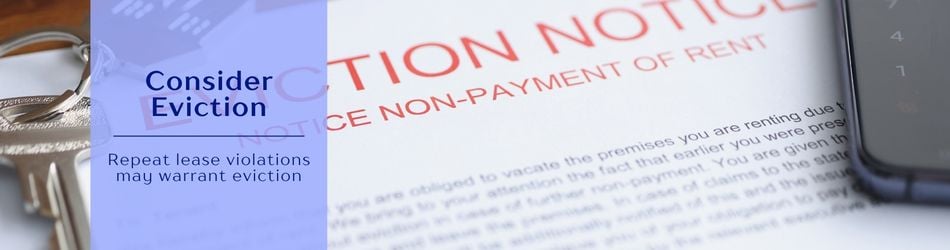
If your problems with a tenant truly cannot be reconciled with boundaries, communication, and clear lease terms, you may need to make the difficult decision not to renew your lease, or even to evict your tenant. This should be thoroughly and carefully thought through before you take the step, but removing a tenant from your property is a good way to put a firm stop to your problems with their behavior.
Eviction is a complex process, and it may take time, but it could be the ideal method of putting an end to a difficult tenant relationship where tenants break their lease terms. It is important to have the option in your pocket, should it be necessary, though.

Final Thoughts
Bad tenants are a challenge for landlords to overcome, and one that can cause quite a headache. But, with the right preparations and planning to respond to issues quickly, you can swiftly resolve these tenant problems and ensure that your experience with tenants is as easy as possible.